Featured
Form Follows Fuel by Barnabas Calder and Florian Urban: excerpt
This is an excerpt from Form Follows Fuel by Barnabas Calder and Florian Urban. Through 14 case studies, their book shows that energy has been the biggest influence on the world’s architecture throughout the history of our species.
Human labour and fossil fuel
Humans, in terms of energy, are extremely weak. An average labourer working over an eight‑hour shift is likely to produce 0.075 kW. A tonne of oil, on the other hand, can replace over 150,000 hours of human labour, or over 19,000 eight‑hour shifts. In 2020, this could be bought for only about £430.
In the medium term, this energy wealth has been a great boon to a huge number of people, although fossil fuels have also supported colonialism and larger, more terrible wars, political instability, corruption, and pollution around the world, and are currently driving a potentially terminal environmental crisis. A large portion of the world’s population today can be plausibly claimed to owe their very existence to fossil fuel energy, given oil’s role in producing fertilisers that help feed 8 billion humans, and given the hygienic and medical interventions that owe parts of their origination and implementation to fossil fuel‑driven science.


Left: Physical labour in ancient Egypt (Elemar/ Wikimedia) | Right: Physical labour in ancient Egypt (NinaDavies/ Wikimedia)
Today’s architecture, too, owes its existence to fossil fuels. The Seagram Building was typical of the architectural trend it did so much to perpetuate. It was and is widely praised for its sober and simple expression, which, in contrast to the nineteenth century’s lush façades, show what Mies van der Rohe considered the basic principles of structure and load. The building is also praised for providing light and air as well as a simple and therefore flexible plan, as the load rests on steel columns rather than restrictive load‑bearing walls.
And yet, the Seagram’s expression of modesty and restraint is based on extremely high energy cost, as country singer Dolly Parton famously quipped, “It costs a lot of money to look that cheap!”14 Mies’s famous dictum that “less is more,” on the other hand, turns out to be missing a word: “less is more carbon.” This does not only concern the materials, but likewise the building’s operational energy. With poor insulation and large glass fronts, the building is extremely wasteful in terms of both heating and cooling, even by American standards.
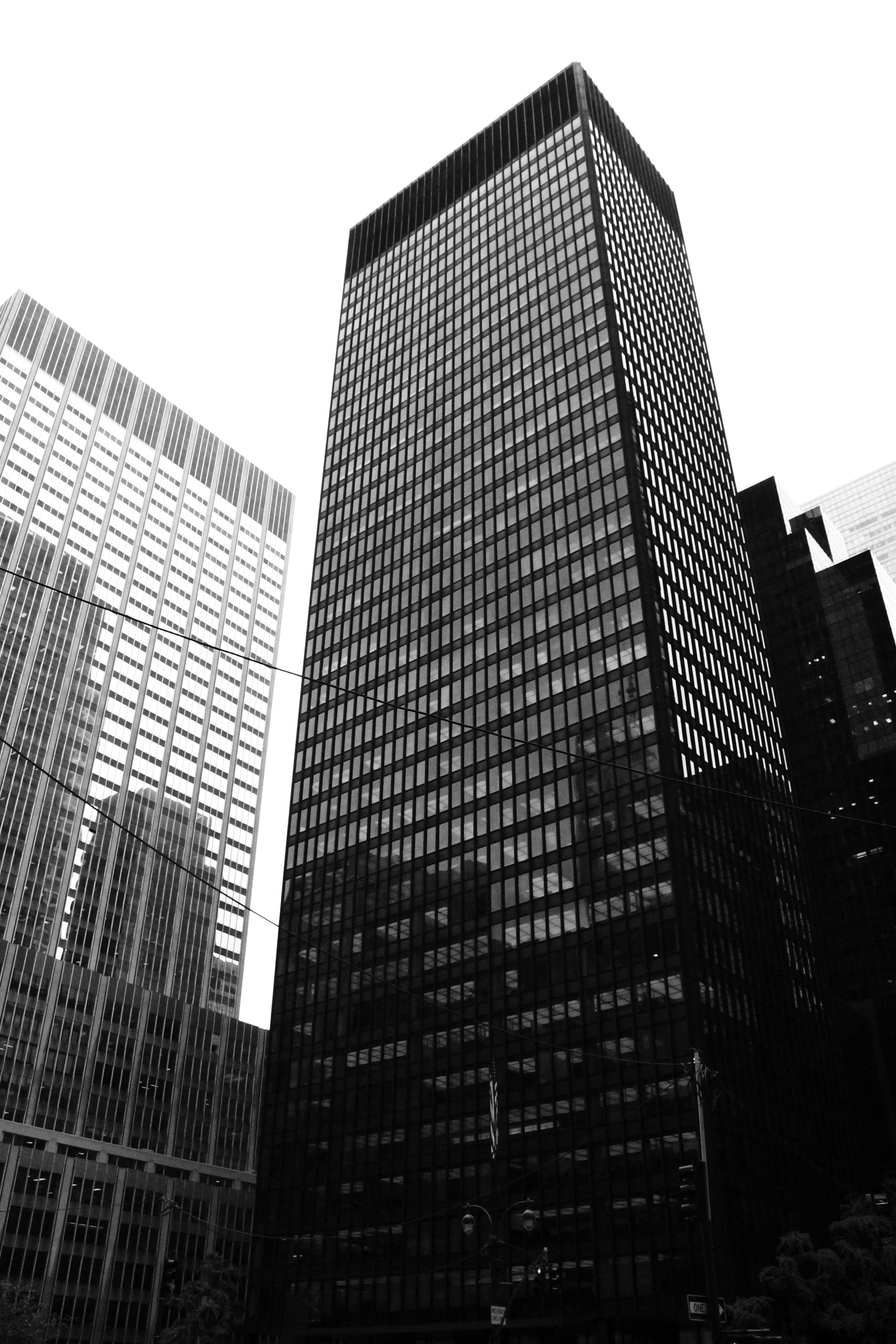
Per square meter of floor space, it used four times as much energy as the average American office building in 2012, when according to the Energy Star rating system by the U.S. Environmental Protection Agency it was rated 3 out of 100.15 To be labelled “energy efficient” a building needed a score of 75 or above. This makes the Seagram Building one of the most energy‑wasteful buildings in New York. This was not seen to matter in the 1950s when oil was cheap, anthropogenic climate change was known to very few, and consuming more energy was an attractive gesture of conspicuous consumption (as in the showy “gas guzzler” cars of the period). In the Seagram Building, artificial lighting – a scarce and valuable commodity even decades before – was provided not by fittings at work locations but by a uniformly lit ceiling bathing the entire interior in bright, even, joyfully unnatural electric light.
With its opulent materials, some of them from far away, conspicuous energy consumption appears to have been part of the building’s message, which proudly touted its owners’ energy wealth. Perhaps even more striking is the ultimate expression of luxury in this machine‑made‑looking building: the considerable amount of skilled human craft that went into perfecting its surfaces of brass and travertine. Phyllis Lambert celebrated the expensive perfectionism which required that the patina coating preserving the gracious colour “was applied to the bronze skin essentially by hand.”16 The elegantly seamless welding of Mies’s steel and brass is ostentatious not because it is machine‑made but on the contrary because it is hand‑made – by the 1950s human labour was expensive, and skilled craft especially so.
14 - Dolly Parton on Twitter, 14 July 2011, https://twitter.com/DollyParton/status/91306847855853568?lang=en (accessed March 2024).
15 - City of New York, 2012 Benchmarking Report.
16 - Lambert, Building Seagram, 65.